How Do Stair Climbing Robot Vacuums Work?
This guide to stair climbing robot vacuums explains the practical details worth knowing before you make your next decision.
Honestly, the idea of a robot vacuum that can navigate stairs used to feel like pure science fiction. For years, we’ve been used to these little discs diligently cleaning our floors, but always stopping short at the first step. That’s why when I started researching the latest in home automation, the concept of a true stair climbing robot vacuum really caught my attention. It’s a significant leap forward for automated home cleaning, promising to bring convenience to homes with multiple levels in a way we haven’t seen before.
But how do they actually do it? It’s not just a matter of a stronger motor. These machines employ a fascinating combination of advanced sensors, intelligent navigation, and specialized mechanical designs to achieve what seems almost impossible. I wanted to understand the core technology that makes these devices tick, so I dug into how stair climbing robot vacuums work, and I’m excited to share what I’ve learned with you.
Table of Contents
The Navigation Challenge: Seeing the Stairs
The first hurdle for any robot vacuum is understanding its environment. For a stair climbing model, this means not just mapping a flat floor but also accurately detecting the edges of stairs. They use a suite of advanced sensors, much like their non-climbing counterparts, including LiDAR or vSLAM (Visual Simultaneous Localization and Mapping) for room mapping. However, they add specialized cliff sensors, which are infrared sensors pointed downwards. These sensors detect a sudden drop-off – the edge of a stair. When these sensors register a significant change, the robot knows it’s at a precipice and needs to adjust its movement. It’s this constant scanning and interpretation of its surroundings that prevents them from tumbling down the stairs.
Climbing Mechanisms: More Than Just Wheels
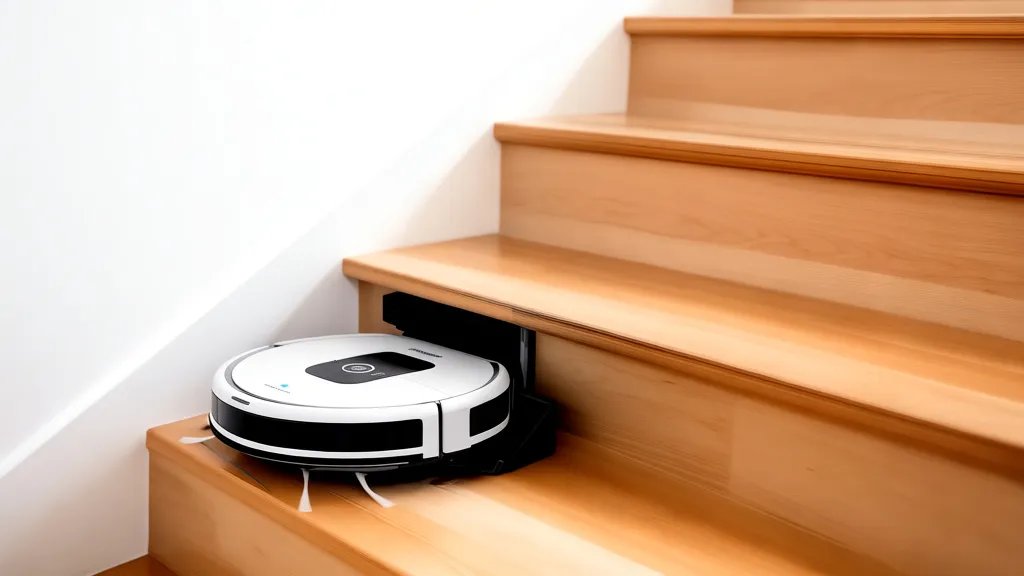
This is where stair climbing robot vacuums really differentiate themselves. On paper, simply having powerful wheels isn’t enough to ascend a vertical riser. Most models I looked at employ a combination of specialized wheel designs and sometimes even articulated arms or tracks. Some use larger, more aggressive wheels with deeper treads to get a better grip on the edge of a step. Others might have a mechanism that allows the body of the vacuum to tilt or pivot, bringing the wheels closer to the edge of the step before engaging. A few innovative designs even incorporate a sort of ‘crawling’ motion, where the wheels engage the riser and the tread, pulling the unit up. It’s a complex mechanical ballet, ensuring the robot maintains traction and stability throughout the climb.
Intelligent Ascent and Descent Logic
It’s not enough for a robot to just ‘see’ a stair and have the mechanical ability to climb. It needs to know *when* and *how* to do it. This involves sophisticated onboard software and algorithms. When the sensors detect a stair edge, the robot’s brain processes this information. It calculates the angle, height, and width of the step. For ascent, it positions itself correctly, engages its climbing mechanism, and applies the right amount of power to move upwards. For descent, it’s even more critical. The robot carefully maneuvers to the edge, often tilting forward, and then uses its sensors to control its descent, preventing a sudden drop. This intelligent logic ensures a smooth, safe transition between floors, which is kind of wild when you think about the processing power involved.
Power and Battery Considerations
Climbing stairs requires significantly more energy than simply rolling on a flat surface. This means stair climbing robot vacuums need robust battery systems and efficient power management. Onboard batteries are typically larger and more powerful than those found in standard robot vacuums. The motors driving the climbing mechanisms also draw considerable power. This can impact overall runtime on a single charge. So, while the convenience is immense, you might find that a stair climbing model needs to return to its charging dock more frequently, especially if it’s navigating a multi-story home extensively. It’s a trade-off: incredible functionality for potentially shorter cleaning sessions between charges.
Frequently Asked Questions
Can all robot vacuums climb stairs?
No, not all robot vacuums can climb stairs. Most standard robot vacuums are equipped with cliff sensors to prevent them from falling down stairs, but they lack the specialized mechanical design and intelligent logic required to ascend or descend them. True stair climbing robot vacuums are a distinct category with advanced features specifically for this purpose.
How do stair climbing robot vacuums avoid falling?
They avoid falling using a combination of advanced cliff sensors and sophisticated navigation software. These cliff sensors are pointed downwards and detect a sudden drop, signaling the robot to stop or change direction. The onboard AI then processes this data to safely navigate around the stair edges, whether it’s cleaning near them or preparing to climb.
Are stair climbing robot vacuums difficult to set up?
Generally, the setup process for stair climbing robot vacuums is similar to standard models. You’ll typically connect them to your Wi-Fi, set up a mobile app for control and scheduling, and let them perform an initial mapping run. The app will usually guide you through defining different floor levels and stair locations. While the technology is complex, the user interface is designed to be intuitive for most buyers.
Useful next reads for this topic include robot vacuum detect dog poop AI, ultra thin robot vacuums, and eufy x9 pro vs Roborock Q revo.
Conclusion
The development of stair climbing robot vacuums represents a significant advancement in home automation. By integrating specialized sensors, innovative climbing mechanisms, and intelligent navigation software, these devices can now tackle the multi-level challenge that has long limited their predecessors. While they require more power and sophisticated engineering, the convenience they offer to homes with stairs is undeniable. If you’ve been waiting for a truly hands-off cleaning solution for your entire home, the technology behind stair climbing robot vacuums is finally making that a reality in 2026.